A morning balloon ride over Luxor’s temples sounds like a dream, and this 5-day cruise makes it real. You’ll pair guided ancient-site time (Valley of the Kings, Karnak, Edfu, Abu Simbel, Philae) with the simple comfort of moving by ship. I particularly like the full-board setup on a 5-star Nile cruise, and I also like the tight guide-led pacing that keeps the stories clear. The one caution: Abu Simbel is a long early day, and hot-air balloon plans depend on weather.
What I love most here is how much you get without feeling rushed between stops. First, the hot-air balloon over Luxor’s west bank gives you a rare aerial sense of how the Valley of the Kings and Deir el-Bahari sit across from modern Luxor. Second, the combination of major temples plus “lesser-seen” stops (like Kom Ombo’s double temple) makes the itinerary feel like more than a greatest-hits playlist.
The main consideration is logistics and timing. You’ll start early for the balloon, and Abu Simbel runs about 7 hours with admission listed as not included, so it’s worth budgeting for that add-on and preparing for a long day.
In This Review
- Key highlights you’ll actually feel in your day
- Why this Luxor-to-Aswan route is so satisfying
- Day 1: West Bank essentials—Valley of the Kings, Hatshepsut, and the Colossi
- Day 2: Hot-air balloon over Luxor, then Karnak and Luxor Temple
- Day 3: Edfu’s Temple of Horus and the double temple at Kom Ombo
- Day 4: The long day to Abu Simbel (and what to expect)
- Day 5: Philae Temple boat trip and the Aswan High Dam
- Price and logistics: is $799.33 a good value?
- Who should book this cruise?
- Should you book it?
- FAQ
- What’s included with the Nile cruise package?
- Do I get hot-air balloon tickets included?
- What happens if the hot-air balloon ride is canceled?
- Is Abu Simbel admission included?
- Do I need to pay tips?
- What are the main sites covered on the trip?
Key highlights you’ll actually feel in your day
- Balloon flight time over Luxor’s west bank (45 to 55 minutes) with hotel-style pickup early in the morning
- Two great temples on the East Bank: Karnak (134-column Hypostyle Hall) plus Luxor Temple
- A rare combination: Edfu’s Temple of Horus followed by Kom Ombo’s unusual double temple
- Abu Simbel with a guided visit that’s long, early, and worth the effort
- Final morning magic: Philae Temple boat trip plus the Aswan High Dam visit
- Full-board cruise comfort: 4 nights on board with breakfast, lunch, and dinner included
Why this Luxor-to-Aswan route is so satisfying
This is one of those trips where the geography does the heavy lifting. You’re working your way south along the Nile, so the big sites come in a logical chain: Luxor’s funerary and royal areas, then the temple wall scenes of Edfu and Kom Ombo, then the big splash of Abu Simbel, and finally Aswan’s Philae and the High Dam.
I like that you get guided time across multiple eras, not just one kind of site. You’ll walk through royal tomb context on the west bank of Luxor, then shift to the east bank’s massive Amun complex at Karnak and its formal counterpart at Luxor Temple. Later, you’ll see the falcon-headed god at Edfu, and then a temple design built like two temples in one at Kom Ombo. The result is variety without chaos.
Another thing that matters for your enjoyment: you’re not constantly changing hotels. The cruise handles your overnight stays for 4 nights on a 5-star ship with full-board meals. That means the day’s big moments are the temples and boat time—not constant packing.
You can also read our reviews of more tours and experiences in Luxor.



Day 1: West Bank essentials—Valley of the Kings, Hatshepsut, and the Colossi
Your first day is built around Luxor’s west bank, the classic opposite-side setting for Thebes’ ancient funerary world. You’re visiting three stops that tell a pretty complete story.
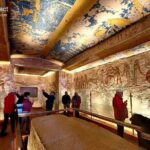
Valley of the Kings is where royalty took the long sleep. This valley served as a burial ground for about 500 years, from the 16th to the 11th centuries BC, and it was used for tombs from the Eighteenth through Twentieth Dynasties. You’ll have about 2 hours, and admission is included. If you want to get your bearings fast, focus on the idea that you’re in a purpose-built royal necropolis—this is not random rocks, it’s planned memory.
Next is the Temple of Hatshepsut at Deir el Bahari. Hatshepsut’s mortuary temple (from the Eighteenth Dynasty) is famous for its monumental, layered approach. It’s also directly tied to the west bank setting across from Thebes and Amun worship in Luxor’s ancient life. Again, you’ll have about 2 hours with admission included.
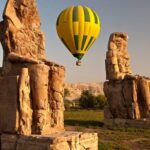
Then comes a shorter stop: the Colossi of Memnon. These two massive statues, built around 1350 BC, are the surviving remnants of a memorial for Pharaoh Amenhotep III. You’ll spend about 30 minutes, with free admission. The good move here is to treat it like a palate cleanser: walk, take in the scale, and then let the guided explanations connect it back to the funerary city theme.
Practical note: west bank sites mean walking and bright sun. Build the day around comfort—hat, water, and shoes you can move in.
Day 2: Hot-air balloon over Luxor, then Karnak and Luxor Temple
If you want the most “wow per hour” moment in this whole itinerary, it’s the early balloon ride.
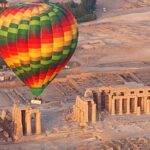
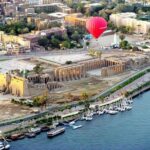
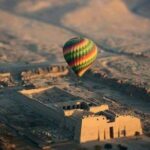
You’ll be picked up early for Hot Air Balloons Luxor, flying for about 45 to 55 minutes over Luxor’s west bank. Admission is included. The payoff is that you’re seeing the city as an open-air museum, with temple shapes and the mountain-and-valley layout all showing up in one view. From above, the west bank stops you visited earlier (Valley of the Kings area and Deir el Bahari) stop being separate labels and start looking like a real map of sacred geography.
After you land and regroup, you’ll shift to the east bank with two heavyweights.
First is Karnak Temple Complex. You’ll have about 2 hours, with admission included. Karnak is built across reigns, but a few landmarks define the experience: the Avenue of Sphinxes, the Hypostyle Hall with 134 towering columns, and obelisks linked to Queen Hatshepsut and Thutmose I. You’ll also see the Temple of Amun details like lotus and papyrus designs and the Sacred Lake. It’s a lot of stone, but with a good Egyptologist guiding the structure, it’s easier to follow than you’d expect.
Then you’ll visit the Luxor Temple, about 2 hours with admission included. This complex was constructed around 1400 BCE, and in Egyptian it’s known as ipet resyt, the southern sanctuary. Luxor Temple often feels more intimate after Karnak’s scale, but it still holds that same sense of ceremonial planning.
Day 3: Edfu’s Temple of Horus and the double temple at Kom Ombo
Day 3 is where the cruise rhythm becomes part of the experience. After breakfast, you’ll go to Edfu.
Temple of Horus in Edfu is your first stop, with about 2 hours and admission included. It’s a well-preserved pharaonic temple dedicated to the falcon-headed god Horus. Edfu also has that layered time feel: in the Hellenistic period it was known by Greek references, and later in Latin terms connected to Apollo through interpretatio graeca. You don’t need to memorize that to enjoy the site. What you should take away is that this temple isn’t just old—it stayed meaningful through different eras.
Then you’ll move to Kom Ombo for the unusual double temple. You’ll have about 1 hour 30 minutes with admission included. The key detail: it’s built during the Ptolemaic dynasty, with some later Roman additions. The design is what catches your eye here, because it’s not one single temple layout—it’s two temples working as one complex, which makes comparisons and explanations easier with your guide.
You’ll have lunch on board as your ship sails toward Aswan, and you’ll overnight in Aswan. That onboard time matters. It gives you a reset between intense temple visuals and helps you keep energy for what comes next.
Day 4: The long day to Abu Simbel (and what to expect)
Abu Simbel is the big set piece of the trip. Early in the morning, you’ll join a guided tour of the Abu Simbel Temple Complex.
Your time here is listed as 7 hours, and admission is not included. That means you should plan for an extra cost on top of the tour price. It also means your day will be long even if the temple visit itself is the star. The good news is that guidance is included, so you won’t just wander through impressive rooms—you’ll understand what you’re seeing and why the site is so dramatic.
After the guided portion, you’ll return to the cruise for lunch, then have ship time in the afternoon and dinner in the evening, plus another overnight on board in Aswan.
This is also the day where you’ll feel the value of staying on the ship rather than hopping hotels. You’re doing a major excursion, but when it’s done, you’re not starting the next transition immediately. You’re back to food, rest, and normal routines.
Tip that’s worth your attention: because Abu Simbel is a long day, keep your essentials easy to grab—camera strap, meds, a small bag you can keep with you during the excursion.



Day 5: Philae Temple boat trip and the Aswan High Dam
Your final day concentrates on Aswan’s most famous spiritual site and its modern engineering story.
At 8:00 am, you’ll check out of the cruise and start your guided tour. You’ll take a boat trip to the Temple of Philae, dedicated to the goddess Isis. You’ll have about 2 hours, with admission included. Philae is known for how the temple setting feels connected to the water, and the boat transfer helps you get in that mood quickly—this is one of those stops where the approach is part of the experience.
Then you’ll head to the Aswan High Dam. You’ll have about 1 hour with admission included. The dam was built across the Nile between 1960 and 1970, and it was the tallest earthen dam in the world when completed. It’s not ancient, but it’s still a major shaping force in the region’s life, and your guide can help connect why it matters in the modern Nile story.
Price and logistics: is $799.33 a good value?
At $799.33 per person, the value here comes from stacking several expensive-feeling pieces into one package.
You’re getting 4 nights on a 5-star Nile cruise, full-board meals (breakfast, lunch, dinner), and an Egyptologist speaking guide for the excursions. You also have pick-up and drop-off by air-conditioned car, plus meet-and-greet support on arrival and departure. On top of that, key tickets are included: Valley of the Kings, Hatshepsut, Karnak, Luxor Temple, Edfu, Kom Ombo, Philae, and the balloon.
The places where you should expect extra costs are spelled out. Tipping for guides, drivers, and Nile cruise crew is not included, and Abu Simbel admission is not included. Also, the balloon has a weather clause: if canceled due to unfavorable weather, you get a refund of $24 per person.
So the real question isn’t whether it’s cheap. It’s whether it saves you time and decision-making. For many people, the comfort of being moved by cruise while you keep one guide thread across Luxor, Edfu/Kom Ombo, Abu Simbel, and Aswan is the point. You pay for that ease.
Who should book this cruise?
This itinerary fits best if you want:
- A guided route through major Upper Egypt sites without constantly planning transfers
- The big Luxor moment of a hot-air balloon ride plus temple days that actually explain what you’re seeing
- A cruise-based pace for nights and meals, with the long excursion days (especially Abu Simbel) built in
It may feel like too much if you hate early mornings or you prefer a slower, self-paced style.
Should you book it?
If you’re excited by the combo of Luxor balloon + guided temples + cruise comfort, I think this is an easy yes. The route hits the classics—Valley of the Kings, Karnak, Abu Simbel, Philae—and it adds texture with Edfu and Kom Ombo rather than skipping the in-between stops.
Before you book, just do two quick checks: confirm you’re comfortable with a long Abu Simbel day, and budget for the items that are not included (tipping and Abu Simbel admission). If that works for you, this is a strong way to see Upper Egypt without turning your vacation into a logistics project.
FAQ
What’s included with the Nile cruise package?
The package includes 4 nights on a 5-star cruise ship with full board (breakfast, lunch, and dinner), an Egyptologist speaking tour guide during excursions, and pick-up and drop-off by air-conditioned car. Meet-and-greet service on arrival and departure is also included, along with admission tickets for many stops.
Do I get hot-air balloon tickets included?
Yes. The hot-air balloon ride over Luxor is included, with about 45 to 55 minutes in the air and admission listed as included.
What happens if the hot-air balloon ride is canceled?
If the hot-air balloon ride is canceled due to unfavorable weather conditions, you’ll receive a refund of $24 per person.
Is Abu Simbel admission included?
No. The Abu Simbel Temple Complex admission is listed as not included, even though the guided tour is included in the schedule.
Do I need to pay tips?
Tipping for tour guides, drivers, and the Nile cruise crew is not included.
What are the main sites covered on the trip?
You’ll visit Valley of the Kings, Temple of Hatshepsut, Colossi of Memnon, Karnak Temple, Luxor Temple, Temple of Horus in Edfu, Temple of Kom Ombo, Abu Simbel, Temple of Philae, and the Aswan High Dam.